Germany's New Right to All-Day Primary School Care: What Started in August 2026 and What It Does Not Guarantee
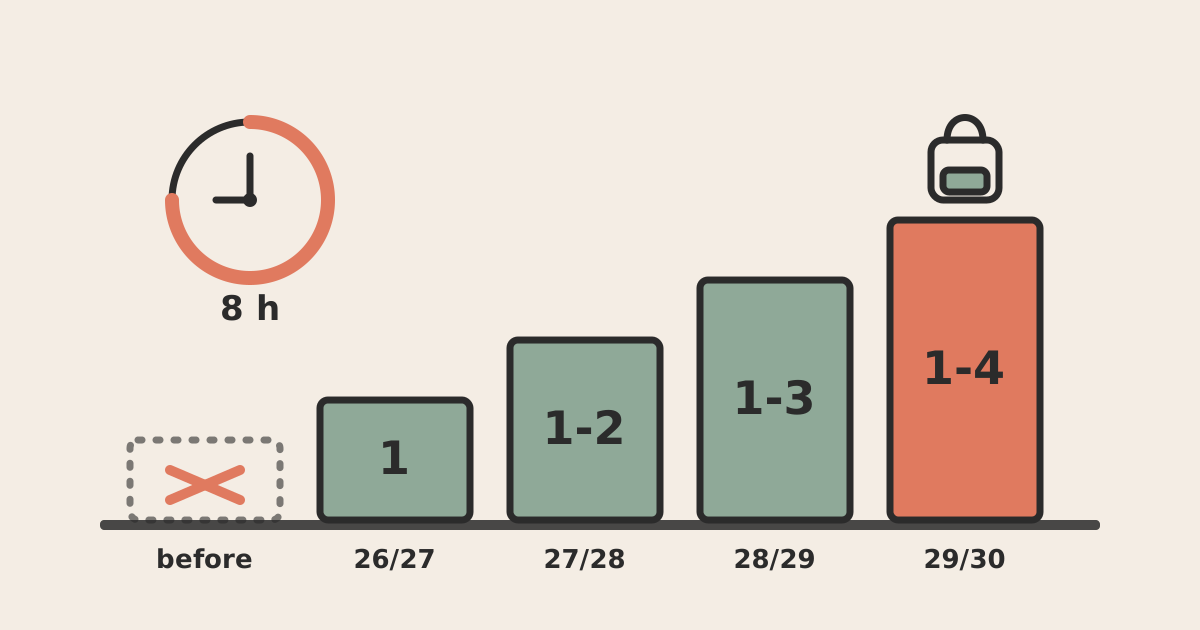
Since 1 August 2026, a child entering first grade has a legal right to eight hours of care per school day (§ 24 Abs. 4 SGB VIII), owed by the local youth welfare office (Jugendamt), not by your school. It is phased in by cohort and reaches grades one to four in 2029/30, so children already in school before 2026/27 do not gain it retroactively. The federal law sets no parent fees and no application route, so deadlines and costs depend on your state and city, and in some places there are still fewer places than eligible children.
What changed on 1 August 2026
For years, after-school care in Germany depended on where you lived and how many places your city had built. Since 1 August 2026 there is a federal legal right behind it. § 24 Abs. 4 SGB VIII gives a child who enters first grade the right to a place in all-day care for eight hours on school days. The federal family ministry (BMBFSFJ) announced the start in its press release of 30 July 2026.
Two things are easy to miss. First, the right is phased in by cohort, not for every grade at once. Second, a right on paper is not the same as a place on a list. The sections below separate the two.
| Child starts first grade in | Covered by the right? |
|---|---|
| Before 2026/27 | No, not retroactively. Only a needs-based offer applies (Abs. 5). |
| 2026/27 | Yes, from 1 August 2026, first grade only. |
| 2027/28 and later | Yes, each new first-grade cohort, so more grades are covered every year. |
| 2029/30 | Grades one to four are all covered. |
What the right actually covers
The law uses a fixed scope, and it is more specific than most explainers suggest.
- Eight hours a day on school days (Werktage in the statute). Lesson time and the hours of an all-day school count toward the eight.
- From school entry through the start of grade five.
- Voluntary. Nobody has to use it, and a child can stay in a half-day arrangement.
- School holidays. State law may allow closing for up to four weeks a year, and offers from youth work under § 11 SGB VIII can count as fulfilment. A federal law listed on the ministry’s page on 7 April 2026 concerns holiday offers from youth work, so ask your Jugendamt how this applies in your state.
Who you ask, and what a “place” means
The right is not against your school and not against the Hort operator. It is owed by the public youth welfare body, in practice your city or district Jugendamt. The Jugendamt decides which suitable place to offer, so the city may propose a different school or a cooperative model than the one you hoped for.
That is why a parent can hold a valid right and still not get the place they wanted.
How the systems differ by state and city
The federal law gives a frame. The state decides the name of the system, the fees, the deadlines and who runs it. This table shows the entry point in the five cities SettledIn covers in depth. Fee tables and step-by-step routes will sit on each city’s own page.
| City / state | System | How you get in |
|---|---|---|
| Munich / Bavaria | Kooperativer Ganztag, Hort, open and bound Ganztag, Mittagsbetreuung | Parents notify demand by 30 April each year (Art. 45b AGSG). Cooperative Ganztag is registered on school enrollment day. |
| Hamburg | GBS and GTS (Ganztägige Bildung und Betreuung an Schulen) | Application at the school office or online. Ask your school for its deadline. |
| Berlin | eFöB, renamed BEB from 2026/27 | Apply to the Jugendamt of your home district, at least three months before the start you want. |
| Cologne / NRW | OGS (offener Ganztag) | Registration at the school office, then a contract with the OGS operator for one school year. Places are tight. |
| Frankfurt / Hesse | Hort and Schulbetreuung under the Pakt für den Ganztag | The city council approved its Ganztag concept in January 2026, with Monday to Friday 7:30 to 17:00 as the frame. Check how to register with the city. |
What is still short
In two scenarios, the federal government’s third report on the expansion estimates up to 30,000 (constant demand) or up to 65,000 (rising demand) additional places for first graders in 2026/27, mostly in western states. Across all primary grades it puts the extra need at about 225,000 places in 2026/27 and 264,000 by 2029/30, as scenario averages.
Trade press, kommunal.de, reported in September 2026 that the picture is very uneven. In Bergisch Gladbach, for example, the city counted 185 children without an OGS place at the end of June, 32 of them holding the legal right. In North Rhine-Westphalia, 15 municipalities have sued the state over financing, and the Düsseldorf administrative court said it does not see itself as competent and treats the matter as a constitutional dispute.
This does not cancel your right. It means the practical question is how early and how clearly you ask.
What the first three months show
There is no official nationwide count of first graders with and without a place yet. The federal government’s fourth expansion report is due in December 2026 (per kommunal.de and Deutsches Schulportal), so the items below are ministry statements, surveys and local counts, as of 8 November 2026. Each item says who counted and when, and whether it covers all of Germany or one state.
- Ministries, Germany-wide (Deutsches Schulportal, 11 September 2026). Asked by the portal, the responsible state ministries mostly said the right will be met for the first cohort. The eastern states were already well supplied. Baden-Württemberg, Schleswig-Holstein and Lower Saxony still show supply gaps for the cohorts that gain the right over the next three years. Bavaria, Baden-Württemberg, Hesse, Rhineland-Palatinate, Saxony and Schleswig-Holstein said they did not yet have first-year registration figures. These are the ministries’ own statements, not independent counts.
- Coverage differs a lot by state (ministry figures, 11 September 2026; KMK statistics, 30 January 2026). Berlin reported 111,703 of 132,514 children in grades one to four in all-day operation (84.3 percent, May 2026). Hamburg reported a 92 percent registration rate and a place for every registered child. Bremen reported an all-day quota of 76 percent among 5,300 first graders, with a place offered to everyone registered on time. For 2025/26, Saarland reported all-day places for 67 percent of its primary school children and Bavaria 60 percent of them in all-day care. The KMK counts schools with an all-day programme, not places: in 2024, 29.3 percent of primary schools in Baden-Württemberg and 56.3 percent in Bavaria (a lower bound, says the KMK) ran one, against 100 percent in Berlin and Thuringia. The measures differ, so do not compare the figures one to one.
- Shortage estimates are projections, not counts (Germany-wide). The federal third report (cabinet, 3 December 2025) expects up to 30,000 or 65,000 additional places for first graders in 2026/27, depending on demand. The Cologne Institute for Economic Research (IW, 23 March 2026) puts the gap at almost 150,000 places by 2029/30 in the nine states with gaps if parents’ stated wishes are the yardstick, with 45,300 in North Rhine-Westphalia and 42,300 in Bavaria. At a 75 percent coverage rate the need is far higher, with more than 204,000 for Bavaria alone. The IW notes that Bavarian parents’ lower stated demand may partly reflect the fees that Bavarian Horte largely set themselves. An older staffing scenario (Bertelsmann Stiftung, 5 July 2022) found that, if every child used full 40-hour care by 2030, 76,000 educators would be missing in the west, and more than 100,000 across Germany if the east also raised its staffing to western levels.
- Pre-start surveys pointed to local gaps (Germany-wide, published January and June 2026). In a forsa survey of 1,312 school heads for the teachers’ association VBE (fieldwork September to October 2025), 67 percent of primary school heads expected to offer all-day care to every new first grader and 25 percent did not, down from 35 percent a year earlier. Those who did not named missing rooms (74 percent), staff (67 percent) and money (47 percent). The German Youth Institute (DJI, 12 June 2026) estimates from its 2024 parent survey that more than 100,000 families had a fully unmet need for after-school care about a year and a half before the start, more of them in the west than in the east.
- North Rhine-Westphalia only (WDR, 25 September 2026; municipal association, 3 September 2026). WDR asked all 396 municipalities in early September and 253 answered. In at least eight of them, parents of 227 first graders who had applied for an OGS place did not get one, and Wuppertal reported places for only about half of its primary school children. The first-grade take-up rate ranged from 94 percent in Cologne and Geldern to 13 percent in Straelen, which WDR puts down to parents not having the same need everywhere. The state’s municipal association (202 municipalities, results published 3 September 2026) found 98 percent expecting to meet the demand of eligible children, while 85 percent reported a lack of rooms and 78 percent a lack of staff.
- Older children can lose out first (North Rhine-Westphalia, Bremen, Bavaria). WDR found children left out of the OGS allocation in at least 15 percent of municipalities, mostly children not yet in the programme, with 2,228 older primary school children on waiting lists, including 733 in Duisburg and 217 in Cologne. Moers told WDR it turned away 21 children from grades two to four because first graders hold the legal claim. About 9 percent of municipalities in the state association’s survey said they had to postpone children without a right or restrict existing offers. kommunal.de (7 September 2026) reports that in Bremen children with the legal claim must be preferred where Hort places are scarce, so third and fourth graders may go without. In Bavaria, the teachers’ association BLLV said before the school year that the right would be met partly at the expense of older children, while the Bavarian social minister said at an event reported by dpa on 31 October 2026 that the start had gone well.
- Quality and fees depend on state and city (kommunal.de, 7 September 2026; DJI, 2 March 2026). There are no nationwide binding qualification rules for all-day staff, and one in five people working in primary school childcare in 2022 had no vocational qualification, twice the share in Kitas (DJI). The NRW decree sets no statewide maximum group size (Nr. 6.7) and allows parent fees up to a monthly maximum that is fixed separately each year (Nr. 8.2), and only half of the municipalities in the state association’s survey have their own quality standards. kommunal.de lists fee examples that are not directly comparable: Bremen income-based from 0 to 279 euros, Dresden 125.43 euros from September 2026 for six hours of Hort, Wiesbaden 147.50 euros for care until 17:00 including holidays plus 85 euros for lunch, and Bergisch Gladbach 70 euros for the edge hours.
- First court decision and lost-earnings claims (Saarland; SR, 31 October 2026). SR reported one of the first decisions since the right began. The administrative court in Saarlouis sided with a family in Altenkessel near Saarbrücken whose child lost a lottery for one of 60 afternoon places for about 240 children and who refused a place at a more distant school. According to SR, the order held that a school change with long travel does not fulfil the right. The Regionalverband Saarbrücken read it as allowing a place elsewhere if direct and safe transport is provided, was negotiating a closer offer, and could still appeal. This is one first-instance decision as reported by the press, not a nationwide precedent. In May 2026 the head of the Saarland association of rural districts had said he did not expect a wave of lawsuits (SR). For lost earnings, the Federal Court of Justice held on 20 October 2016, for under-three places, that parents can in principle claim damages from the municipality if a timely registered child gets no place, with fault presumed at first sight and general lack of money no excuse (the cases went back to the lower court to decide fault and amount). No decision found so far applies this to Ganztag.
- Money: Bund, states and municipalities disagree (2025 to 2026). The federal government provides 3.5 billion euros in investment aid, of which the states had approved 49.5 percent by 28 August 2025, and raises the states’ VAT share from 135 million euros in 2026 to 1.3 billion euros a year from 2030 (third federal report). A federal law of 17 July 2025 moved the investment programme’s deadlines back by two years, the main one to 31 December 2029 (Bundesgesetzblatt). The Deutscher Städtetag says several states do not pass the federal operating-cost money on to cities in full. In NRW, 15 municipalities filed declaratory suits against the state, the Düsseldorf administrative court indicated it is not competent and sees a constitutional dispute, a ruling was in prospect by the end of 2026 if the cases continue, and the NRW Städtetag is examining a constitutional complaint (kommunal.de, 7 September 2026). In Bavaria, municipal associations put the remaining annual deficit at 700 million euros while the state holds 461 million euros in its expansion funding programme (kommunal.de; the two figures measure different things). Funding gaps are the municipalities’ warning, not a measured effect on your child’s place. In our reading, they could show up as higher fees, larger groups or thinner holiday care.
What comes next. The right grows by one grade each school year, as in the table above. NRW’s education ministry says 590,000 primary school places will be needed by 2029/30 and expects to reach that a school year earlier (Deutsches Schulportal, 11 September 2026).
If you move between states. The sources describe the right as federal and owed by the local youth welfare office, while the system, fees, deadlines and quality are set by the state and city. The DJI notes that supply depends strongly on where families live and varies between states and between urban and rural areas, and that school-age care is organised far more variably than pre-school care. Three points follow from the reports. Ask the new Jugendamt in writing which registration deadline applies, because Bremen reported a place for everyone registered on time while Saarbrücken schools held lotteries. A child who entered first grade before 2026/27 has no enforceable federal right and may rank behind first graders. And expect fees and group sizes to differ from your old city. None of the sources tracks families who move, so this is a reading of the evidence, not a rule.
German words you will meet on the forms
Application pages and letters use the official terms, and they are rarely translated. These are the ones that matter here.
| German term | What it means here |
|---|---|
| Jugendamt | The local youth welfare office. It owes you the right and decides which place to offer. |
| Ganztag | All-day care and education for school-age children. |
| Hort | An after-school care centre for primary school children. |
| OGS (offener Ganztag) | The name of the system in North Rhine-Westphalia, run by an operator at the school. |
| GBS / GTS | Hamburg's all-day school models. |
| Träger | The operator of a place. The right is against the Jugendamt, not the Träger. |
| Werktage | The statute's word for the eight-hour days. It usually means Monday to Saturday in legal German. |
| Widerspruch | A formal written objection to a decision. Keep the date you send it. |
| Bescheid | An official decision letter. Read the deadline for objection printed on it. |
Step by step: what to do as a parent
- Find out your city’s route in the year before first grade. Check whether your state wants a notice (Bavaria asks by 30 April) or an application (Berlin about three months ahead, Hamburg through the school).
- Apply at the same time as school enrollment where your city allows it. In Munich this is the same occasion.
- Ask for the fee table in writing. Part of childcare cost can be deducted, see our guide on the childcare tax deduction.
- Plan the school holidays separately. The eight-hour right does not mean your Hort is open all summer. See the summer closure gap in Munich.
- If you get no place, put it in writing to the Jugendamt. Keep the date, and do not sign for a private provider expecting reimbursement without legal advice first.

Photo by Norma Mortenson on Pexels
Real life: what a refusal looks like
A report summarised by gegen-hartz.de in August 2026 described a mother in Remscheid who had looked for an OGS place for about a year and was refused in May, because the free places went to the new first graders. Her child was seven and already in an older grade, so the new right did not apply to them. One city’s example proves nothing about yours, but it shows how the cohort rule can play out.
This section reflects independent press coverage and the official sources above, not a promise about your own city.
This page is general information, not legal advice. Rules, fees and deadlines are set by your state and city, so check the official source of your own city before you decide.
FAQ & Common Pitfalls
Does my child in second or third grade have this right too?
Not under the federal rule. § 24 Abs. 4 SGB VIII ties the right to the cohort that starts first grade in 2026/27 or later, so a child who was already at school before that does not gain it retroactively. For older primary school children the law only requires a needs-based offer (Abs. 5), which is not a right you can enforce in the same way. Every primary grade is covered only from 2029/30, once your child's cohort has moved up.
Does the right mean a place at my own school?
No. The right is owed by the youth welfare office, and the Jugendamt decides which suitable place to offer. That can be an all-day school, an OGS, a Hort or a cooperative model, and it may not be the one you hoped for. In Remscheid, free places went to new first graders first. Commentators say such a priority can be justified when places are scarce, if the city applies its criteria consistently.
How many hours does it actually cover?
The law says eight hours per Werktag, and lesson time counts toward them. In German legal usage Werktage usually means Monday to Saturday, and the statute does not spell out five days. The federal government's third report nevertheless describes the right as eight hours on five days a week, and in practice offers run Monday to Friday, as in Frankfurt's concept. State law may allow closing for up to four weeks in the school holidays, and holiday offers from youth work (§ 11 SGB VIII) can count toward fulfilling the right. Bavaria also says there is no claim for 20 Werktage of the holidays. Your state and city set the exact hours.
Do I have to pay?
The federal law does not set parent fees, states and cities do. In Berlin, care in grades one to three currently carries no fee. In Hamburg the core hours from 8:00 to 16:00 are free, and care outside them is income-based. In Munich, open and bound Ganztag at school is free on school days (lunch extra), city-run cooperative Ganztag (KoGa) and Tagesheim follow the city's income-based fee tables, and other providers set their own fees. NRW sets a monthly maximum separately by state decree. Always check the current fee table of your own city.
What if the city has no place for my child?
The federal text names no separate sanction. Secondary sources discuss an objection (Widerspruch) and, in urgent cases, an application to the administrative court. A 2017 Federal Administrative Court ruling on under-three care is sometimes cited. In October 2026 the press reported one of the first court decisions on the new right, from the administrative court in Saarlouis in favour of a first grader's family, but no higher court has settled how the rule applies to primary school. For lost earnings, a 2016 Federal Court of Justice ruling on under-three places allowed damages claims against a municipality, and whether that carries over to Ganztag is untested. Put your request in writing to the Jugendamt, keep the date, and get legal advice before paying for a private place yourself.
Is this guaranteed to work everywhere from day one?
No. In two scenarios the federal government's third report expects up to 30,000 (constant demand) or up to 65,000 (rising demand) additional places for first graders in 2026/27, mostly in western states. Local reports in September 2026 show large differences between cities. Treat the right as a legal claim that is still being turned into real places.
We are moving to another state: does my first grader keep the right, and what changes?
The sources describe the right as a federal one, owed by the local youth welfare office, so the right itself should not depend on the state. What changes is the system, the registration deadline, the fees and the quality, which the state and city set. A move in the middle of a school year is not covered in the sources read, so ask the new Jugendamt in writing how and by when to register. A child who entered first grade before 2026/27 has no enforceable federal right, and local reports show such older children can rank behind first graders on waiting lists.