
Converting Your Foreign Driver's License in Munich: Who Needs an Exam and Who Doesn't
EU and EEA driving licenses stay legal to drive in Munich indefinitely for most private classes, so converting one is optional rather than urgent. Everyone else gets six months from the date their Munich residence is registered before the foreign license stops counting as valid, and what happens next depends entirely on where the license was issued: a specific list of countries in Anlage 11 of the Fahrerlaubnis-Verordnung convert with no exam or a partial one, while every other country, Turkey included, since no recognition agreement exists between Ankara and Berlin, means both a written and a practical driving test at the KVR. Complete applications currently take up to 14 weeks to turn into a physical card, so the six-month clock is tighter than it looks.
The Official Rule
Munich’s Führerscheinstelle, part of the Kreisverwaltungsreferat (KVR), handles every driving license conversion for residents of the city, and the rule that decides how much work is ahead of you comes down to a single question: which country issued the license currently in your wallet.
If it’s an EU or EEA country, the good news is that in most cases you don’t need to do anything. A standard EU/EEA driving license without commercial classes (C, C1, C1E, CE, D, D1, D1E, DE) stays fully valid to drive in Germany for as long as the card itself is valid: no conversion, no exam, no appointment required. Converting is voluntary, worth doing mainly if the card gets lost or damaged, or once its own expiry date comes up (cards issued since 2013 run for 15 years). Licenses carrying those commercial classes are the exception: once the class-specific validity period on the card runs out, converting to a German license becomes mandatory.
Everyone else, meaning any license issued outside the EU/EEA, is on the clock the moment they establish residence in Germany. From that date, in practice the date your Munich Anmeldung takes effect, you have six months in which the foreign license, together with a certified translation, remains valid for driving. After that window closes, driving on the foreign license alone counts as driving without a valid license under Section 21 of the Straßenverkehrsgesetz, a criminal offense rather than a parking-ticket-level fine. A one-time extension of another six months exists, but only if your total stay in Germany won’t exceed twelve months, which rules it out for most families actually settling in Munich for the long term.
What happens inside that six-month window splits into two very different paths, and Anlage 11 of the Fahrerlaubnis-Verordnung (FeV), the federal driving license regulation, is the document that decides which one applies. It lists a specific set of countries and territories, among them Switzerland, Japan, South Korea, Israel, New Zealand, Singapore, Taiwan, the United Kingdom, South Africa, Namibia, and most US states and Canadian provinces, whose driver training is judged broadly equivalent to Germany’s, and which in turn recognize German licenses too. Holders of a license from a country on that list can usually convert directly, with no exam or, for a handful of vehicle classes and states, a limited theory or practical test.
Turkey is not on that list. It’s worth being direct about this because it’s a genuinely common assumption among Turkish nationals moving to Munich, especially given the reciprocal social-security arrangements Germany and Turkey do have in other areas. No such recognition agreement exists for driving licenses, and the federal law text itself confirms Turkey’s absence from Anlage 11. A political inquiry to the Bundestag on exactly this question, whether Turkey might be added to the list, drew a response confirming that recognition of third-country licenses, Turkey included, is currently being discussed as part of a broader EU driving license directive renegotiation, with no concrete timeline attached. Until that changes, a Turkish driving license converts through the same path as any other non-Anlage-11 country: both a theoretical and a practical driving test at the KVR, with no requirement to attend formal driving school lessons first, only to pass the two exams.
| License issued in | Exam required | Examples |
|---|---|---|
| EU / EEA country | None, conversion is optional | Any EU/EEA member state |
| Anlage 11 FeV country | None, or a partial exam for some vehicle classes | Switzerland, Japan, South Korea, Israel, New Zealand, Singapore, Taiwan, the UK, South Africa, Namibia, most US states and Canadian provinces |
| Any other country | Full theory and practical exam | Turkey, and every other country without a recognition agreement |
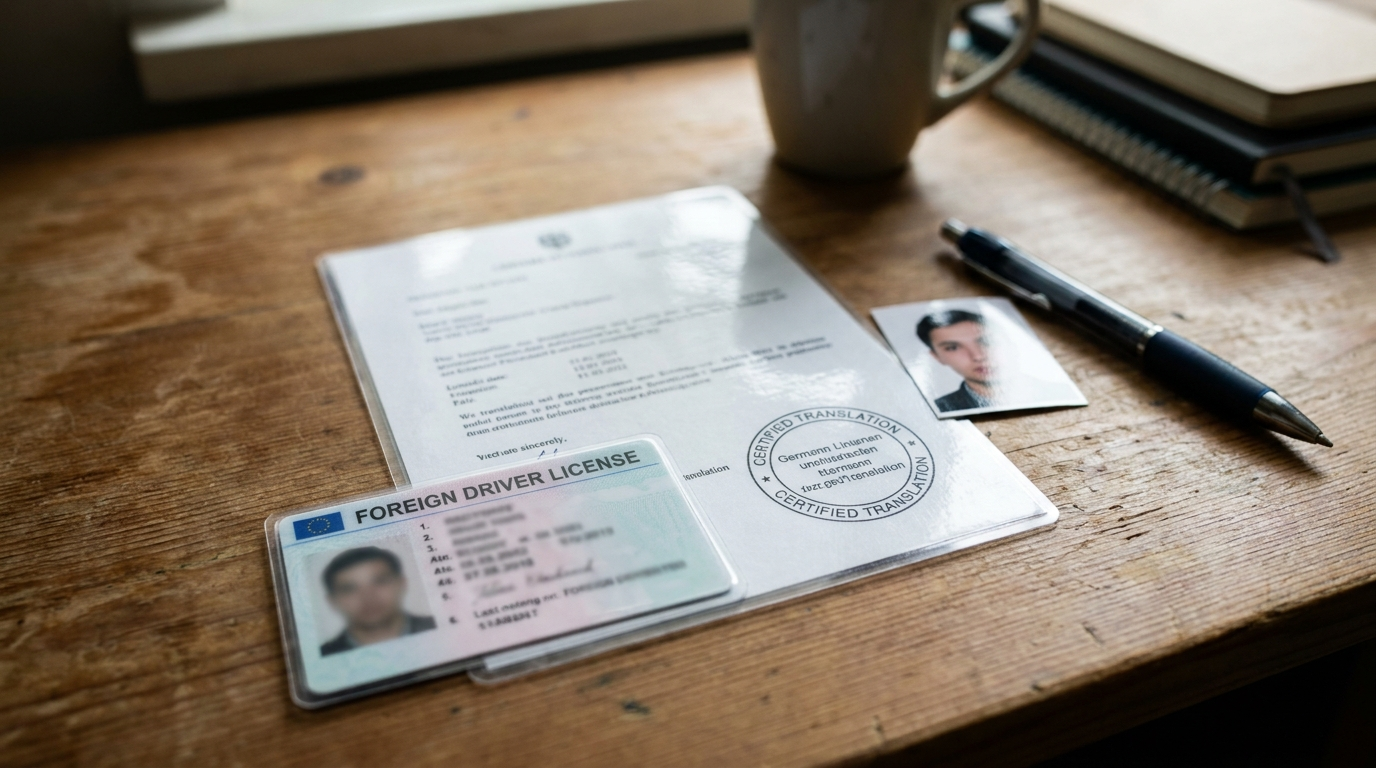
Regardless of which path applies, the KVR’s document list overlaps heavily: a valid passport or ID, a biometric passport photo, the original foreign license (don’t send the only copy without a plan to get it back), and an extended Meldebescheinigung (registration certificate) showing exactly when your residence in Munich began, since that date is what the six-month clock runs from. If the license isn’t in German and doesn’t match the 1968 Vienna Convention format, a certified translation from a translator sworn in Germany is required, a translation done back home generally won’t be accepted. Classes A, A1, A2, AM, B, BE, L, and T additionally need a vision test (Sehtest) and a first aid course certificate (Erste-Hilfe-Kurs); classes C and CE require a fuller medical and eyesight examination on top of that. Fees run from roughly 37.50 euros for a straightforward conversion up to around 45.90 euros where an exam or class restriction is involved, and once your file is complete, budget up to 14 weeks before the physical card, produced centrally by the Bundesdruckerei in Berlin, actually arrives. Appointments at the Führerscheinstelle (Garmischer Straße 19-21) are booked online through the KVR’s system, and the office doesn’t take walk-ins.
Führerscheinstelle (KVR): Garmischer Straße 19-21, 80339 Munich. Appointments are booked online only, the office doesn't take walk-ins.
What Real People Say
This section draws on established expat guides covering the same non-EU conversion process elsewhere in Germany.
The most consistent complaint across those guides isn’t the exam itself, it’s timing. Several describe applicants who assumed the six-month window was generous, only to discover that between booking an appointment, gathering a certified translation, and waiting for the Führerscheinstelle to actually process a complete file, weeks disappear fast. The advice that comes up again and again: start the appointment booking and the translation in parallel, in month one or two of your Munich residence, not month four.
A second recurring warning: if your original foreign license gets renewed or replaced after you’ve already moved to Germany, some authorities ask for proof that you held a valid license before your move, and a freshly reissued document can complicate that proof. Keeping the old physical card, or at least a dated copy, even after a renewal is a small precaution that saves a real headache later.
On the exam side, guides covering non-Anlage-11 conversions, the same track Turkish nationals are on, consistently note that formal driving school attendance isn’t legally required; you can, in principle, book the theory and practical test directly. In practice, most people still take at least a handful of lessons with a local Fahrschule, partly because German road rules and right-of-way conventions differ enough from many other countries’ that walking in with zero local driving experience is a real risk, and partly because a Fahrschule can often help book test slots faster than navigating the system alone.
Step by Step
- Identify which path applies to you. Check whether your license was issued by an EU/EEA country (usually no action needed), an Anlage 11 country (simplified or no-exam conversion), or any other country including Turkey (full theory and practical exam). If you’re unsure, the KVR Führerscheinstelle can confirm by phone before you book anything.
- Start the clock math immediately. Your six months run from the date your Munich residence begins, not from your move-in date if the two differ. Mark the deadline somewhere you’ll actually see it.
- Book your KVR appointment early, through the KVR’s online booking system. Appointments fill up, and the 14-week processing estimate only starts once your file is complete, not once you’ve booked.
- Line up a certified translation of your original license from a translator sworn in Germany, if it isn’t already in German or Vienna Convention format. A translation from your home country generally won’t be accepted.
- Get your vision test and first aid course done early if your classes require them (A, A1, A2, AM, B, BE, L, T). Both are quick to book but easy to forget until the appointment is close.
- If you’re on the exam track, register for the theory and practical tests as soon as you know your file is moving, whether or not you take Fahrschule lessons first. Nobody outside an Anlage 11 country of origin gets to skip either exam, Turkish nationals included.
- Bring the extended Meldebescheinigung, not the basic Anmeldung confirmation, since it’s the document that proves your residence start date to the caseworker.
- Don’t let the deadline slip. Driving on an expired foreign license is treated as driving without a valid license, a criminal offense rather than a formality, and it can also void your insurance coverage if you’re in an accident.
FAQ & Common Pitfalls
Does Turkey have any special arrangement for converting driving licenses in Germany?
No, and it's worth saying plainly because it's a common assumption, especially given the reciprocal agreements Germany and Turkey do have in other areas like social security. Driving licenses aren't one of them: Turkey doesn't appear on the Anlage 11 FeV list of countries that convert without an exam or with only a partial one, and the underlying federal law text confirms this directly. A Bundestag inquiry asking whether that might change drew a response confirming that third-country license recognition, Turkey included, is currently part of a broader EU driving license directive renegotiation, with no fixed timeline attached. Until an actual change is published, a Turkish license converts through the standard non-Anlage-11 path: both a theory and a practical test, the same as licenses from any other country with no agreement in place. If your plans depend on this changing, check the KVR or the current Anlage 11 text directly closer to your appointment rather than relying on this page's snapshot.
Do I actually need to convert my EU or EEA license?
Usually not, at least not right away. A standard EU/EEA license without commercial classes like trucks or buses stays fully valid to drive in Germany for as long as the card itself is valid, with no exam and no deadline forcing a conversion. Converting becomes worth doing mainly if the card is lost or damaged, or once its own expiry date comes up (cards issued since 2013 run for 15 years). It becomes mandatory only if your license carries commercial classes whose validity period is running out. If neither applies to you, it's genuinely fine to keep driving on your original EU license.
Do I have to attend a Fahrschule (driving school) before taking the German exams?
Not legally. If you're converting an existing license rather than learning to drive from scratch, formal lessons aren't a requirement to sit the theory or practical test, you can in principle study independently and book both exams directly. That said, most applicants on the exam track still take a short block of lessons anyway, partly because German right-of-way rules and road signage can differ enough from other countries' that walking into the practical test with zero local driving experience is a real risk, and partly because a Fahrschule can help navigate the test-booking system faster than doing it alone.
What actually happens if I miss the six-month deadline?
Once the six months from establishing residence run out, your foreign license, if it's from outside the EU/EEA, stops being valid for driving in Germany. Getting behind the wheel after that counts as driving without a valid license under the Straßenverkehrsgesetz, a criminal offense rather than a fine, and it's also likely to void your insurance coverage if you're in an accident. A one-time six-month extension exists, but only for people whose total stay in Germany won't exceed twelve months, so it doesn't help most families settling in for the long term. If you're at risk of missing the window, book your KVR appointment immediately and explain the timeline rather than waiting for the deadline to pass first.