Registering a Balkonkraftwerk: Just One Form, Not Two, Since 2024
Registering a Balkonkraftwerk (a plug-in balcony solar system) got noticeably simpler in May 2024: you now only need to register it once, in the federal Marktstammdatenregister (MaStR) run by the Bundesnetzagentur, and Stadtwerke München as your local network operator gets the information automatically from that register, no separate SWM notification required anymore. Registration itself is free, takes only a few minutes online at marktstammdatenregister.de, and needs your commissioning date, the number and total peak wattage of your solar modules, your inverter's wattage, and your electricity meter number. You have one month from the date the system starts operating to register it, and skipping this is technically a regulatory offense (Ordnungswidrigkeit) under Section 5 of the MaStRV that can theoretically carry a fine up to 50,000 euros, though real-world penalties for a missed registration tend to be far lower than that ceiling. Since May 2024, the systems this covers can have solar modules totaling up to 2,000 watts peak, with an inverter output capped at 800 watts.
The Official Rule
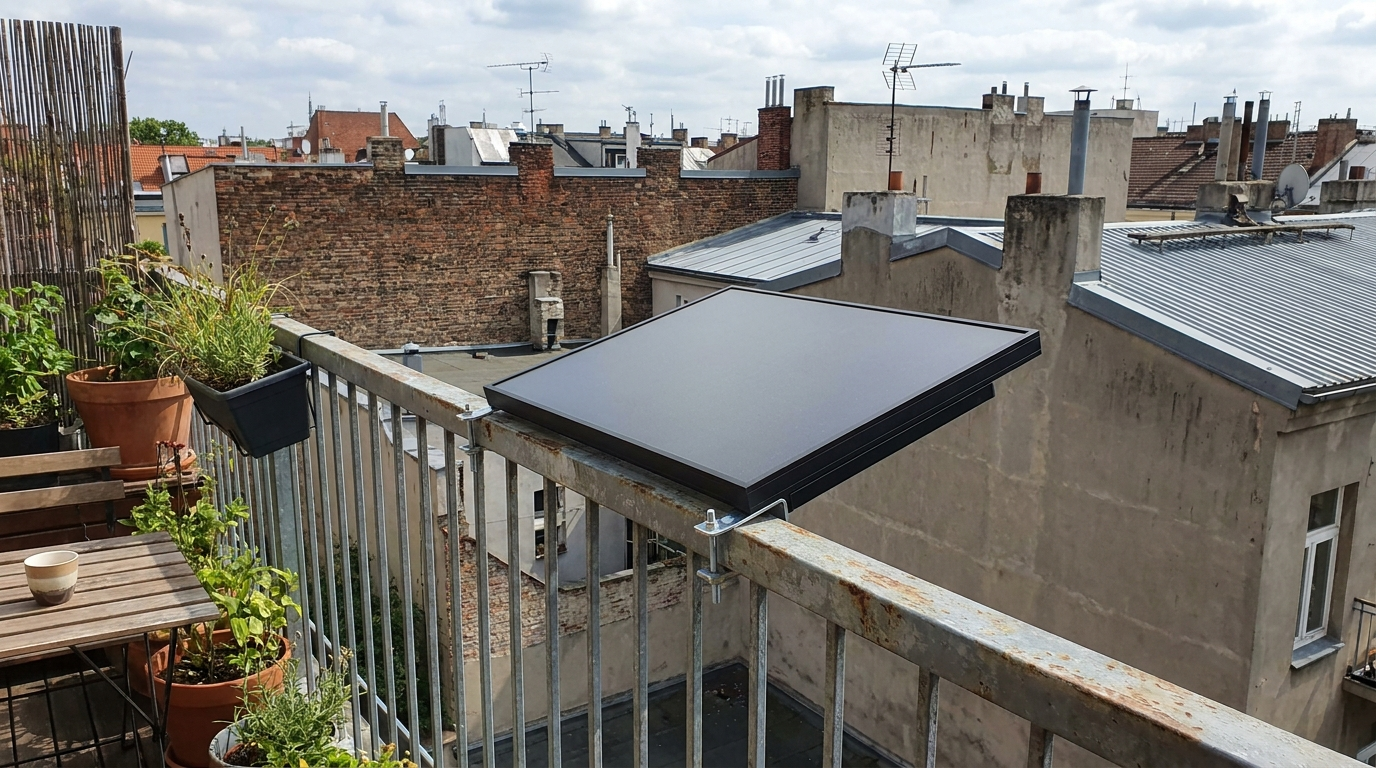
If you’re setting up a Balkonkraftwerk, a small plug-in solar system mounted on a balcony railing, the registration process is genuinely simpler than it used to be, and it’s worth knowing exactly what changed.
Since May 2024, only one registration is required: the federal Marktstammdatenregister (MaStR), run by the Bundesnetzagentur. Before that reform, owners also had to separately notify their local network operator, Stadtwerke München in Munich’s case, but that step has been eliminated: SWM now receives your system’s information automatically from the federal register itself, with no extra form or contact required on your end.
| Detail | Current rule |
|---|---|
| Where to register | marktstammdatenregister.de only, since May 2024 |
| Separate SWM notification | No longer required, SWM gets data automatically |
| Deadline | 1 month from commissioning date |
| Cost | Free |
| Solar module limit | Up to 2,000 watts peak, combined |
| Inverter limit | Up to 800 watts |
| Missed deadline | Technically an Ordnungswidrigkeit, fine up to 50,000 euros theoretically, real penalties typically far lower |
The registration itself is quick and free. At marktstammdatenregister.de, you’ll need your commissioning date (when the system actually started operating), the number of solar modules and their combined peak wattage, your inverter’s output wattage, and your electricity meter number, and the whole process typically takes just a few minutes online. You have one month from your commissioning date to complete it. Current limits allow solar modules totaling up to 2,000 watts peak, with the inverter itself capped at 800 watts of output to the grid, figures that increased under the same 2024 reform that removed the separate network operator step.
What Real People Say
The detail worth taking seriously despite the simplified process is that skipping registration entirely is technically a regulatory offense (Ordnungswidrigkeit) under Section 5 of the MaStRV, with a legal maximum fine as high as 50,000 euros. That figure is a ceiling rather than a typical outcome, real-world penalties for a missed or late registration tend to run far below it, but it’s not worth treating registration as optional just because enforcement may be inconsistent in practice.
Given how quick and free the process actually is now, especially compared to the two-step system that existed before May 2024, there’s little practical reason to delay once your system is up and running.
Step by Step
- Note your exact commissioning date, the day your Balkonkraftwerk actually started operating, since your one-month registration window starts from there.
- Gather your system details: module count and combined peak wattage, inverter wattage output, and your electricity meter number.
- Register at marktstammdatenregister.de, the process is free and typically takes just a few minutes.
- Don’t separately contact Stadtwerke München, this step was eliminated in May 2024, SWM receives your data automatically from the federal register.
- Complete registration within one month of commissioning to stay within the legal deadline and avoid the (unlikely but real) risk of a fine.
- Confirm your system stays within current limits: 2,000 watts peak for the modules combined, 800 watts for the inverter.
Compliance Note
This page explains the general Balkonkraftwerk registration process and current limits under German federal regulation, current as of mid-2026. It is not legal or technical installation advice. Confirm current requirements directly at marktstammdatenregister.de before registering your specific system.
FAQ & Common Pitfalls
Do I still need to notify Stadtwerke München separately when I set up a Balkonkraftwerk?
No, not since May 2024. Before that, you needed to register both with the Marktstammdatenregister and separately with your local network operator. Now a single registration in the federal Marktstammdatenregister is enough, and SWM receives your system's information automatically from that register.
What information do I actually need to have ready to register?
Your commissioning date (the date the system started operating), the number of solar modules and their combined peak wattage, your inverter's wattage output, and your electricity meter number. The registration itself is done online at marktstammdatenregister.de and takes only a few minutes.
What happens if I miss the one-month registration deadline?
Missing it is technically a regulatory offense (Ordnungswidrigkeit) under Section 5 of the MaStRV, and the law allows for a fine theoretically as high as 50,000 euros. In practice, real-world penalties for a late or missed registration tend to be substantially lower than that maximum, but it's still worth registering promptly rather than assuming it doesn't matter.
What are the current power limits for a Balkonkraftwerk?
Since May 2024, the solar modules can total up to 2,000 watts of peak output, while the inverter itself is capped at 800 watts of output to the grid. These limits changed from the previous rules, so if you're referencing older guidance, double check it reflects the current figures.