Munich's Schulstraßen: What Happens When Your Street Closes to Cars Before School
If your child's school sits on or near a Schulstraße, the street itself closes to regular car traffic for a genuinely short but strict window, weekdays from 7:30 to 8:00am, year-round including school holidays, to keep the chaos of parents driving directly to the gate (Elterntaxis) away from where children are actually walking. Munich currently runs two of these, around Grundschule an der Forellenstraße in Trudering-Riem (its first, running since February 2026) and around Grundschule an der Lehrer-Wirth-Straße (its second, since June 15, 2026), both approved permanently rather than as time-limited experiments. Emergency services, waste collection, and residents or businesses with a paid permit can still enter, and every closed street has a designated Bring- und Holzone nearby where a genuine quick drop-off is still allowed, you just can't drive all the way to the door. Driving through the closure anyway costs a real 50 euro fine, on top of a further 40 to 85 euros if you stop in the accompanying no-parking zone, and this legal basis (§ 45 Abs. 1 Satz 2 Nr. 7 StVO) exists specifically because German surveys consistently show most parents themselves think other parents drive their kids to school far too often.
The Official Rule
A Schulstraße is exactly what it sounds like: a street or stretch of street immediately around a school that closes to regular vehicle traffic for a short, fixed window right before classes start. In Munich specifically, that window is weekdays, Monday through Friday, from 7:30 to 8:00am, and it runs year-round, including school holidays, deliberately, so the pattern stays consistent rather than confusing drivers who only encounter it some weeks. The city’s own legal basis sits in § 45 Abs. 1 Satz 2 Nr. 7 StVO, the clause covering traffic safety and environmental protection measures, and the reasoning stated openly is that the volume of Elterntaxis, parents driving directly to the school gate, especially at morning rush hour, was creating genuinely unclear and dangerous conditions right where children are on foot.
Munich currently runs two Schulstraßen, both intended as permanent, not experimental. The first surrounds Grundschule an der Forellenstraße in the Trudering-Riem district, covering Brachsenstraße and the northern stretch of Forellenstraße up to Böcklerweg, operating since late February 2026. The second surrounds Grundschule an der Lehrer-Wirth-Straße, covering Lehrer-Wirth-Straße itself (south of Erika-Cremer-Straße), Caroline-Herschel-Straße, and Elisabeth-Dane-Straße, running since June 15, 2026. The city council approved the underlying program in March 2025, and the Mobilitätsreferat is evaluating these two locations to help decide where else it might make sense, though no specific list of future schools has been published.
Grundschule an der Forellenstraße, Forellenstraße 5, 81825 München, Trudering-Riem. Munich's first Schulstraße, restricting Brachsenstraße and the northern stretch of Forellenstraße to Böcklerweg, weekdays 7:30-8:00am.
Not everyone loses access, and there’s a real alternative for a genuine drop-off. Emergency and medical vehicles can enter unrestricted at any time, and waste collection and street cleaning keep their normal access too. Residents living in the closed zone, and people who work or run a business there, can apply for a permit valid for three years, at a small fee, that allows continued entry. Ambulance transport and caregivers visiting a resident who needs care are also covered without needing to apply in advance. For everyone else who genuinely needs to drop a child off by car, each Schulstraße has a designated Bring- und Holzone just outside the restricted area, at Damaschkestraße for the Forellenstraße school and at Erika-Cremer- and Maria-Montessori-Straße for the Lehrer-Wirth-Straße school, where a brief drop-off is fine, extended parking while searching for a spot is not.
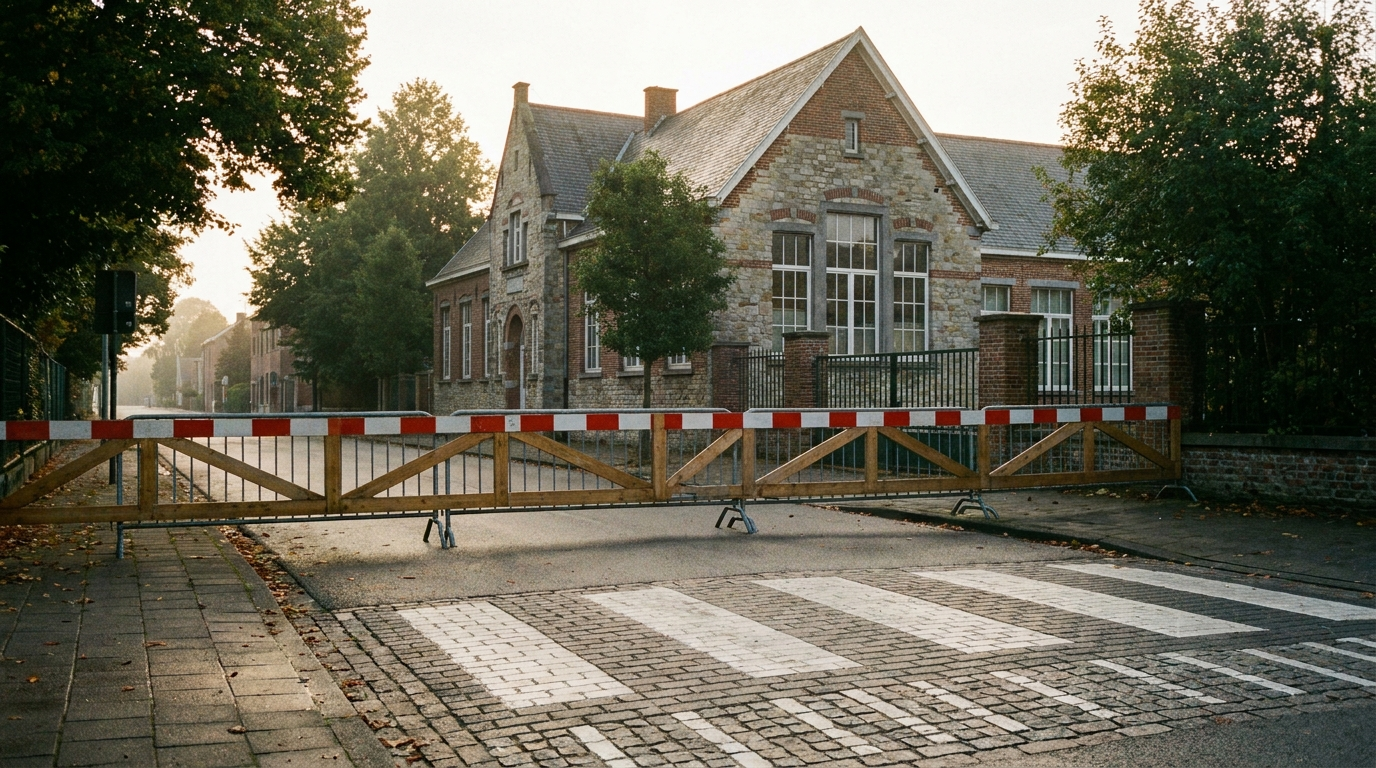
Driving through anyway is a real, priced violation, not a theoretical one. stvo2go.de’s explainer confirms the standard fine for driving a car through a street closed with a Zeichen 250 or 260 sign is 50 euros, and stopping in the accompanying absolute no-parking zone adds a further 40 to 85 euros on top of that. Police work alongside the city on enforcement, and Munich installs physical barriers, temporary fencing at first, to make the closure genuinely obvious rather than relying on signage alone.
What Real People Say
The push behind Schulstraßen isn’t a top-down assumption that parents are doing something wrong without evidence, survey data backs it up directly, and from parents themselves. A 2024 Forsa survey commissioned by the TÜV-Verband found 92% of the German public, and 94% of parents with school-age children specifically, think children are driven to school too often, a striking degree of self-aware agreement. Separately, an ADAC Stiftung survey found 19% of primary schoolers are driven by car every single day, with another 9% driven every other day, yet 58% of parents say they personally oppose the Elterntaxi habit in principle. The gap between attitude and behavior comes down to specific pressures: parents cite after-school appointments (40%), bad weather (32%), the school being on their own commute route (30%), and straightforward time savings (22%) as their reasons for still driving, while only 12% point to safety concerns, suggesting the habit is more about daily logistics than a genuine judgment that walking or biking isn’t safe enough.
Step by Step
- Check whether your child’s school is one of Munich’s two current Schulstraßen (Forellenstraße in Trudering-Riem, or Lehrer-Wirth-Straße), since the restriction only applies to those specific streets right now.
- If it is, plan around the 7:30-8:00am weekday window, it applies year-round including school holidays, so it’s a permanent part of your routine, not a seasonal thing to work around occasionally.
- Use the designated Bring- und Holzone for a quick drop-off, not the closed street itself, and don’t treat the zone as extended parking while walking your child the rest of the way.
- If you live or work inside the restricted zone, apply for a resident or business permit, it’s valid for three years at a small fee and restores your regular access.
- Don’t risk driving through anyway, the fine is a real 50 euros for the closure violation alone, more if you also stop in the adjacent no-parking zone.
- If your own habit leans on the Elterntaxi more than you’d like, consider Munich’s free Bus mit Füßen walking school bus program as a genuine alternative for at least part of the week.
Compliance Note
This page reflects Munich’s Schulstraßen program as it operates in mid-2026, covering the two locations active at time of writing. The city may add further Schulstraßen following its evaluation of these two; confirm current restrictions, permit requirements, and Bring- und Holzone locations directly with muenchenunterwegs.de or your child’s school before assuming a specific street is or isn’t covered.
FAQ & Common Pitfalls
Can I still drive my child directly to a Munich school that has a Schulstraße?
Not down the closed street itself during the 7:30-8:00am weekday window, that's specifically what the measure blocks. Every Schulstraße has a designated Bring- und Holzone (drop-off zone) nearby, on a street just outside the closure, where a brief, genuine drop-off is still fine. What's not permitted is treating that zone as extended parking while you walk your child the rest of the way, the point is to keep the search-for-a-spot traffic away from the immediate school gate.
What if I actually live on a street that becomes a Schulstraße?
Residents living within the restricted zone, along with people who work or run a business there, can apply for a permit that allows continued access. The permit carries a small fee and is valid for three years. Ambulance transport and caregivers visiting residents who need care are also covered. You don't lose access to your own street, you just need the paperwork rather than assuming free entry.
Is this just a temporary trial, or will it expand to more schools?
Munich's city council explicitly designed Schulstraßen as a permanent measure, not a time-limited traffic experiment, and the program received council approval in March 2025 before the first street went into effect. The Mobility Department (Mobilitätsreferat) is evaluating the two existing locations to inform whether and where more get added, but no specific list or timeline for further expansion has been published yet.
Why does this exist, isn't the school drop-off just a normal part of the morning?
Survey data backs up why the city is doing this. A 2024 Forsa survey for the TÜV-Verband found 92% of the general public, and 94% of parents of school-age children specifically, think children are driven to school too often. An ADAC Stiftung survey found 19% of primary schoolers are driven daily and another 9% every other day, yet 58% of parents say they oppose the Elterntaxi habit in principle. The reasons parents give for still doing it: after-school appointments (40%), bad weather (32%), the school being on the way to work (30%), and time savings (22%), only 12% cite safety as their reason.