Tipping in German Restaurants: Why Cash Still Wins Over Card
Tipping (Trinkgeld) in Germany runs on a much smaller scale than in the US, typically 5 to 10 percent, and roughly half of Germans reported tipping in that 5-to-10-percent range in a 2025 survey by payment platform Lightspeed. Cash remains the practical default for handing it over, even though card terminals almost always support adding a tip too, and there are two real reasons behind that preference. First, every card transaction triggers a processing fee charged to the business on the full amount, bill plus tip together, so businesses sometimes prefer cash tips simply to avoid absorbing that extra cost. Second, plenty of guests genuinely aren't sure whether a tip added through the card terminal actually reaches their server rather than just becoming part of the restaurant's own revenue, a concern that comes up repeatedly in German consumer guidance on the topic. Legally, industry representatives are clear that a tip belongs to the employee it's given to, regardless of whether it was paid in cash or by card, but that legal principle doesn't fully resolve the practical trust gap that keeps cash the more common choice at the table.
The Official Rule
If you’ve paid your restaurant bill by card without a second thought, then hesitated over how, or whether, to add a tip, you’re running into a genuine cultural and practical gap, not just a personal quirk.
German tipping (Trinkgeld) runs on a noticeably smaller scale than in the US: 5 to 10 percent is the commonly cited range, typically rounded up to a convenient total rather than calculated precisely. A 2025 survey by payment platform Lightspeed, covered by nw.de, found that roughly half of Germans reported tipping within that 5-to-10-percent range that year, reinforcing that this is a real, widely followed norm rather than just a rule of thumb nobody actually uses.
| Factor | What it means in practice |
|---|---|
| Typical tip size | 5 to 10 percent, rounded up to a convenient amount |
| Card processing fee | Charged to the business on the full bill-plus-tip total, not just the bill |
| Guest trust concern | Some guests aren't confident a card tip reaches the server directly |
| Legal ownership of the tip | Belongs to the employee regardless of cash or card, per industry representatives |
Cash’s staying power as the preferred way to tip comes down to two separate, very concrete factors rather than pure habit. Every card transaction generates a processing fee charged to the business, and that fee is calculated on the full amount processed, meaning the bill and the tip together, not the bill alone. A restaurant happy to take your bill by card may still specifically prefer the tip in cash simply to avoid absorbing an extra fee on money that’s meant to go straight to staff. Second, as utopia.de discusses, plenty of guests genuinely wonder whether a tip added at the card terminal actually reaches their server rather than simply folding into the restaurant’s own revenue, since it becomes part of one processed transaction rather than cash changing hands directly. Industry representatives are clear on the legal principle, a tip belongs to the employee it’s intended for no matter how it’s paid, but that legal clarity doesn’t fully erase the practical uncertainty that keeps many guests reaching for cash instead.
What Real People Say
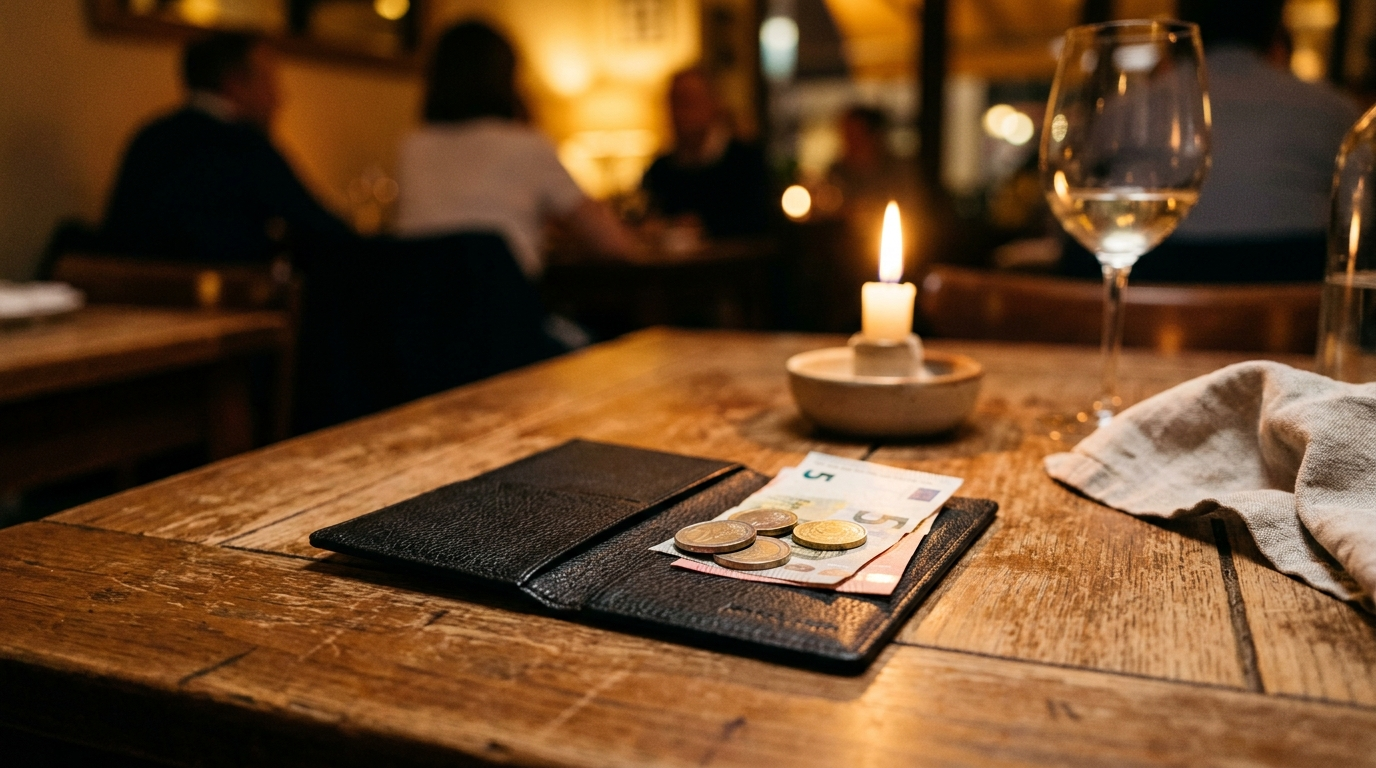
The trust question comes up again and again in German consumer discussions of this exact topic: not whether tipping by card is technically possible (it almost always is now, either the server enters the amount manually or you select a percentage on a touchscreen), but whether doing so guarantees the money ends up with the person who served you rather than simply becoming part of the restaurant’s books. That uncertainty, more than any fixed rule, is what keeps a lot of people defaulting to handing over a few coins or a small note directly.
The practical middle ground many people land on is straightforward: pay the bill itself however’s convenient, card is completely normal for that, and keep a small amount of cash on hand specifically for the tip if you want to be certain it goes directly to the person who served you.
Step by Step
- Budget roughly 5 to 10 percent of the bill as a normal tip, and round up to a convenient total rather than calculating an exact percentage.
- Keep some small cash on hand for tipping, even if you plan to pay the bill itself by card, since cash sidesteps both the processing-fee issue and the trust question.
- If you do tip by card, say the total amount you want to pay out loud (bill plus tip) rather than assuming the terminal will prompt for a tip automatically, not every setup does.
- Don’t feel obligated to tip 15 to 20 percent out of habit from elsewhere, 5 to 10 percent is the genuinely normal range here, not a stingy version of a different country’s norm.
- Remember tipping is voluntary, not a wage replacement, so a smaller tip for so-so service, or none at all, isn’t treated as a serious breach of etiquette the way it might be in some other countries.
Compliance Note
This page explains general German tipping norms and the reasons cash remains common for tips, current as of mid-2026. It is not legal or financial advice, and actual practice can vary by establishment, region, and individual preference.
FAQ & Common Pitfalls
How much should I actually tip at a restaurant in Germany?
Five to ten percent of the bill is the commonly cited range, and it's typically rounded up to a convenient amount rather than calculated to the exact cent, for a 27 euro bill, rounding up to 30 euros is a completely normal tip rather than adding a precise percentage. A 2025 survey by payment platform Lightspeed found that roughly half of Germans tipped within that 5-to-10-percent range that year.
If I tip by card, does the server actually get it?
Legally, yes, industry representatives are clear that a tip belongs to the employee it's intended for, regardless of payment method. In practice, though, plenty of guests aren't fully confident about this, since a card tip becomes part of a single processed transaction with the restaurant rather than money handed directly to a person, and that uncertainty is a real, commonly discussed concern, not just an assumption on your part.
Why would a restaurant prefer I tip in cash instead of by card?
Cost. Every card payment generates a processing fee charged to the business, and that fee applies to the full transaction amount, meaning the bill and the tip together, not just the bill. A restaurant that would otherwise absorb a fee on your tip on top of the fee on your bill has a genuine financial reason to prefer that tip specifically in cash, even if they're happy to take the bill itself by card.
Is it rude not to tip at all in Germany?
Tipping in Germany is considered a voluntary gesture rather than a wage-replacing obligation the way it functions in some other countries, so leaving nothing isn't treated as a serious breach of etiquette the way it might be elsewhere. That said, a small tip in the 5-to-10-percent range for good service is the common, expected norm, and most Germans do tip within that range rather than skipping it entirely.