Munich's Free Krabbelgruppe and Familienzentren Network, Where German Parents Actually Meet
Munich runs its own city-wide network of Familienzentren, neighborhood family centers with a searchable directory on the city's own website, and this is where most German parents actually meet other families with young children, not through an app or a private class. Many core offerings are genuinely free and need no registration at all: an open Familiencafé you can simply walk into, and in several centers a dedicated, no-cost internationale Mutter-Kind-Gruppe aimed specifically at newcomer families. Structured Krabbelgruppen (crawling groups) and PEKiP courses usually run on top of that for a modest fee and do need sign-up, since spots are limited by room size. Individual centers, ELKI Schwabing, the Familientreffpunkt Giesing, the Evangelical Elly Heuss-Knapp institute, and the ETC's Familienzentrum im Harthof among them, each set their own exact schedule and language mix, so the real first step is finding the one closest to your address rather than assuming they're all the same.
The Official Rule
Munich runs its own city-wide network of Familienzentren, and the city’s own directory is the actual starting point most newcomer families miss, since it’s easy to assume playgroups only exist through word of mouth or a private course provider. The directory covers dozens of locations spread across Munich’s districts, each with its own address, hours, and specific program mix, and it includes a location-based search so you can find whichever center actually sits closest to your registered address.
Not every Familienzentrum offers the same thing, since the exact mix depends on each center’s own space, staffing, and neighborhood. What’s broadly consistent across the network: an open Familiencafé, described by the city as the actual heart (Herzstück) of a Familienzentrum, where parents and children simply drop in during posted hours with no registration or fee, alongside more structured offerings, open consultation hours on pregnancy, birth, parenting, or relationship questions, sports and relaxation sessions, babysitter matching, and creative activities like cooking, singing, or supervised outings. Several centers specifically run a free internationale Mutter-Kind-Gruppe, aimed directly at newcomer and international families rather than assuming everyone attending is a fluent German speaker.
| Center | District | What it's known for |
|---|---|---|
| ELKI Schwabing | Schwabing-West | Café with playroom, English and Spanish playgroups, baby meetups |
| Familientreffpunkt Giesing | Ober-/Untergiesing | Family and counseling center for ages 0 to 6 |
| Elly Heuss-Knapp Bildungsstätte | Altstadt-Lehel | Evangelical family education institute, Krabbelrunden 0 to 1 |
| Familienzentrum im Harthof (ETC) | Milbertshofen-Am Hart | Newer center, opened September 2023 |
- 1 ELKI Schwabing (Nordendstraße 53, 80801 München): café with playroom, English and Spanish playgroups, baby meetups and courses.
- 2 Elly Heuss-Knapp Bildungsstätte (Herzog-Wilhelm-Str. 24, 80331 München): evangelical family education institute, Krabbelrunden Eltern-Kind for ages 0 to 1.
- 3 Familientreffpunkt Giesing (Pöllatstraße 15, 81539 München): family and counseling center serving Ober- and Untergiesing, ages 0 to 6.
- 4 Familienzentrum im Harthof (Kämpferstraße 10, 80937 München): newer ETC-run center, opened September 2023.
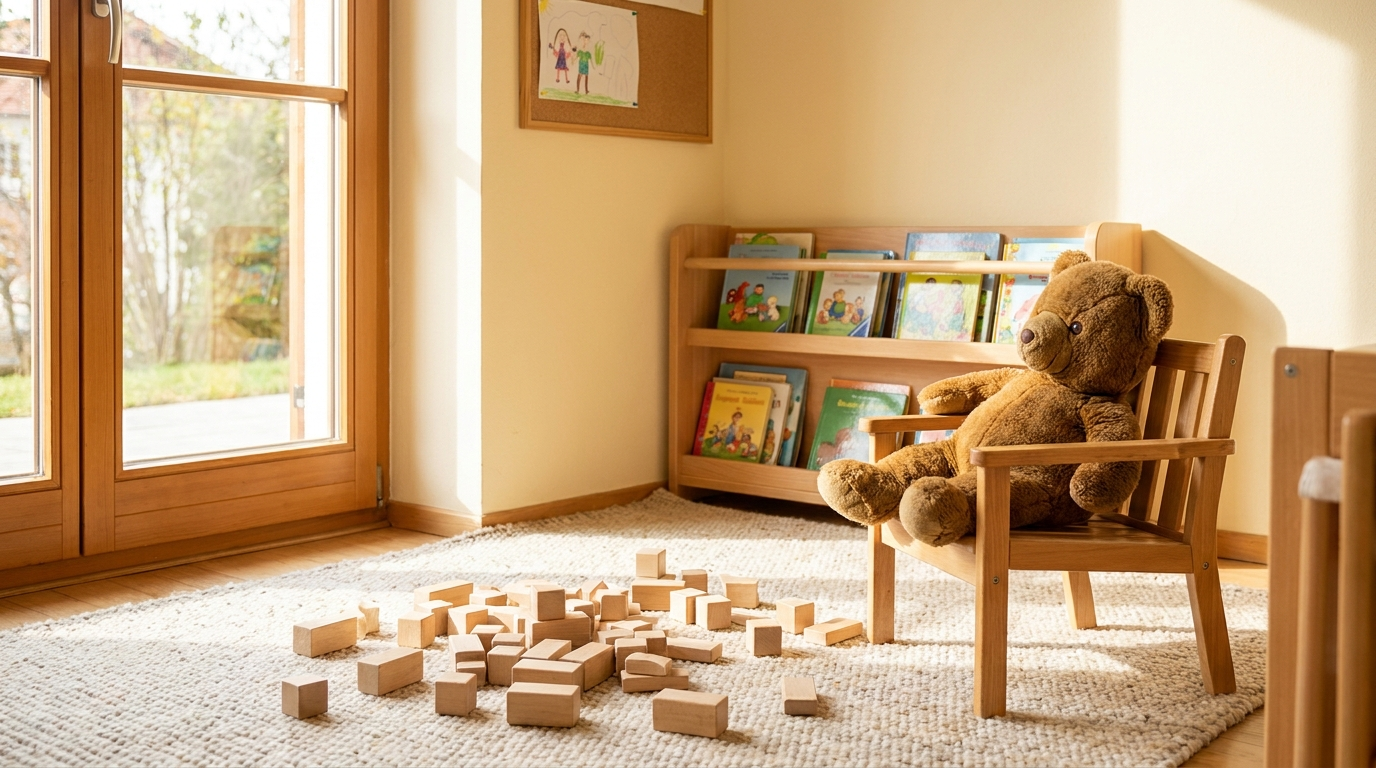
Structured groups, a specific Krabbelgruppe time slot or a PEKiP cycle (the nationally recognized Prager-Eltern-Kind-Programm), usually cost a modest per-session or per-cycle fee and require signing up in advance, since a room only fits so many parent-baby pairs at once. This is different from the open Familiencafé, which stays free and walk-in specifically so a family can try a center out before committing to a paid course there. Registration itself is simple, generally a phone call or a form on the center’s own website, and doesn’t route through any city bureaucracy or your child’s Kita.
What Real People Say
This section draws on the individual centers’ own program pages and city directory listings covering how these groups actually run day to day.
The consistent picture across these sources is that a Familienzentrum works less like a class and more like a genuinely open community space that happens to also run some paid courses. ELKI Schwabing’s own description leans into this directly, framing itself as a place with “a café with playroom, baby meetups, courses and events for children and parents,” rather than a single fixed activity. The Familientreffpunkt Giesing describes itself as the actual central point of contact for families with children aged 0 to 6 in its two neighborhoods, a role that goes beyond playgroups into general family support and counseling. What comes through across all of them is that showing up to the open café first, before committing to any paid course, is a low-pressure way to see whether a given center’s crowd, language mix, and schedule genuinely fit your family before you invest in anything structured.
Step by Step
- Search the city’s own Familienzentren directory by your registered address rather than assuming every center is the same or picking one at random.
- Start with the open Familiencafé at your nearest center, it’s free, needs no registration, and lets you gauge the crowd and atmosphere before committing to anything paid.
- Ask directly whether the center runs a free internationale Mutter-Kind-Gruppe if your German is still developing, several do, specifically for newcomer families.
- If you want a structured Krabbelgruppe or PEKiP slot, call or check the center’s website to register in advance, spots are limited by room size and fill up.
- Don’t assume cost tracks who runs the building. Check the specific program’s own price, not whether the center is city-run, church-run, or an independent association.
- If the first center you try doesn’t feel like the right fit, try a second one nearby. Each center sets its own schedule and mix of families, and Munich’s network has enough locations that a short walk or tram ride often opens up a genuinely different option.
FAQ & Common Pitfalls
Do I need to speak German to join a Krabbelgruppe or the open Familiencafé?
Not at the open, drop-in offerings, and several centers run a dedicated internationale Mutter-Kind-Gruppe specifically because plenty of parents show up with limited or no German. A structured Krabbelgruppe or PEKiP course run entirely in German will obviously involve more spoken German from the group leader, but the actual point of these groups, for both you and your baby, is social contact and play, not a language class, and parents describe picking up everyday phrases naturally just from being there regularly.
Do I need to register with the city or my Kita to use a Familienzentrum?
No, Familienzentren are open, walk-in community facilities, not something tied to your child's Kita enrollment or your Anmeldung status. The open Familiencafé at most centers needs no registration at all, you simply show up during posted hours. Structured courses inside the same center, a specific Krabbelgruppe time slot or a PEKiP cycle, usually do need you to sign up in advance since space is limited, but that's a booking with the individual center directly, not a city bureaucratic process.
Is there a cost difference between a city-run Familienzentrum and one run by a church or independent association like ELKI or the GfSA?
The organization behind a center (city, an evangelical or Catholic association, an independent gGmbH like ETC) doesn't reliably predict whether a specific offering is free. Open drop-in cafés tend to be free regardless of who runs the building, while structured, instructor-led courses tend to carry a modest fee at almost any center, church-run or otherwise, since these usually cover materials and a paid group leader's time. Check the specific program you're interested in on that center's own page rather than assuming based on who operates it.