
Using a German Birth Certificate Abroad: Apostille First, Then Translation, Never the Other Way Around
If you need your child's German birth certificate recognized in another country, most foreign authorities want two things: an apostille confirming the document is genuinely German, and a certified translation of it. The apostille, issued by a German authority or court, is the simplified stand-in for full consular legalization and works for any country that's part of the Hague Apostille Convention, which covers most destinations families realistically need. For the small number of countries outside that convention, Canada, the UAE, and China among them, you need full consular legalization through that country's embassy instead. The sequence genuinely matters: get the apostille first, then have a sworn translator translate both the original document and the apostille together in one pass. Translating first and getting the apostille afterward produces a translation that doesn't cover the apostille itself, and many receiving authorities won't accept that as complete.
The Official Rule
When a German birth certificate needs to be used in another country, whether for a passport application, a residency claim, a school enrollment, or any other official purpose, two separate pieces of paperwork typically come into play, and understanding both, in the right order, saves a genuinely common and frustrating do-over.
The apostille confirms that a German document is authentic, for use in the international legal system. It’s issued by a competent German authority or court, and it functions as a simplified alternative to full consular legalization, but only for countries that are members of the Hague Apostille Convention. For those countries, the apostille alone is enough, no embassy visit, no additional multi-step confirmation chain. For the smaller set of countries outside that convention, Canada, the United Arab Emirates, and China among them, the apostille route doesn’t apply, and you instead need full consular legalization, a more involved process arranged through that country’s own embassy or consulate.
| Apostille | Consular legalization | |
|---|---|---|
| Applies to | Hague Convention member countries | Non-member countries (e.g. Canada, UAE, China) |
| Issued by | German authority or court, one step | Multi-step, German and foreign authorities both involved |
| Where to start | The German authority holding the original document | The destination country's embassy or consulate |
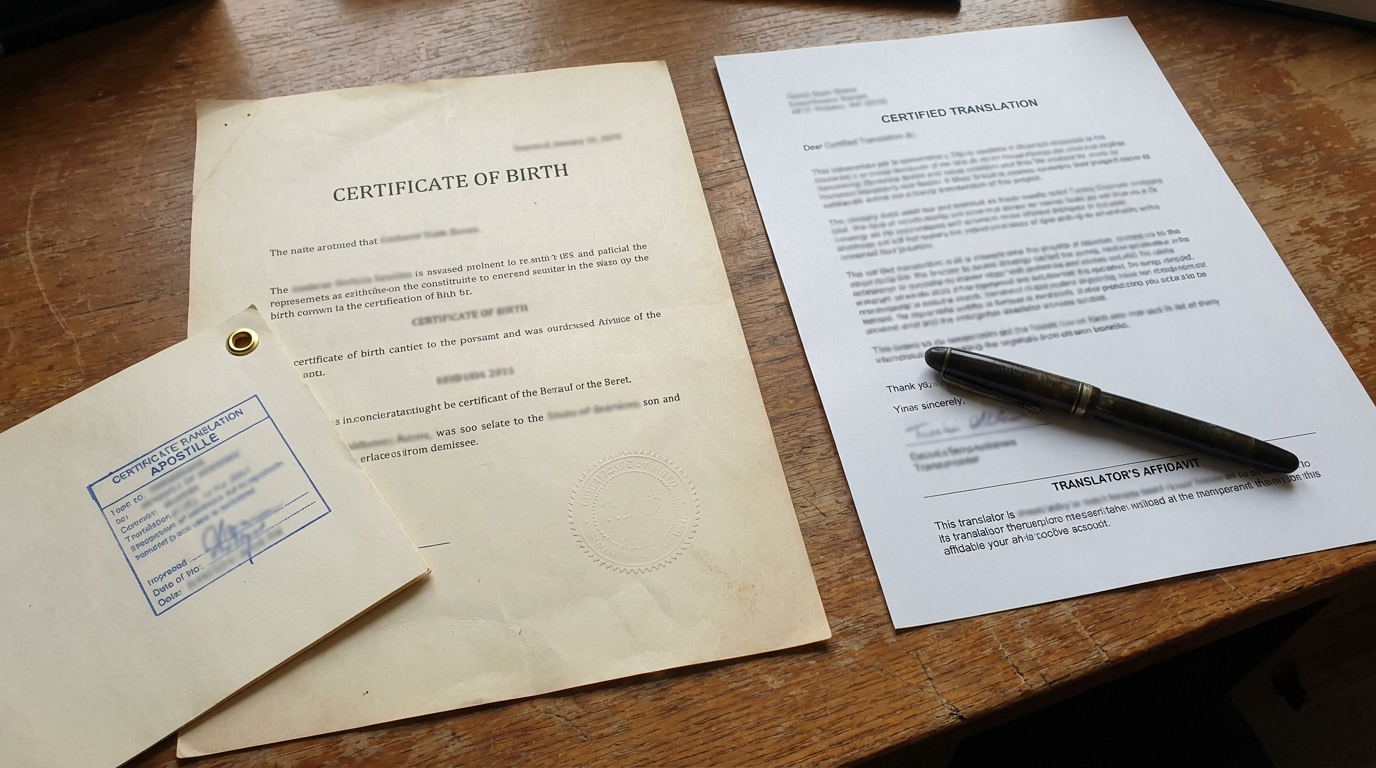
Most receiving authorities abroad want more than just the apostilled original, they want a certified translation as well, and specifically a translation covering both the underlying document and the apostille itself. This is where sequencing genuinely matters and where families most commonly lose time: the apostille has to be obtained before the translation is done, not after. A sworn translator needs both pieces in hand to translate them together as a single unit, and a translation completed before the apostille exists simply won’t include a translated version of it, which many foreign authorities won’t accept as a complete submission. Getting this order backward means redoing the translation from scratch once the apostille is finally in hand.
For documents that German authorities themselves are reviewing, foreign-language documents you’re submitting here rather than sending abroad, the general expectation runs the other direction: the translation should come from a translator sworn in or officially recognized specifically in Germany, not simply “certified” somewhere else. The same logic of checking the specific receiving authority’s requirements before assuming any translator will do applies in both directions.
What Real People Say
The apostille-before-translation sequencing mistake comes up repeatedly enough in practical guidance on this topic that it’s clearly one of the more common, avoidable errors families make. The pattern people describe is understandable: translation feels like the more obviously necessary step, so it gets arranged first out of a sense of urgency, and the apostille request gets treated as a formality to add on afterward, when the actual requirement runs the opposite way.
The other consistent piece of advice is to confirm the specific receiving country’s status, Hague Convention member or not, before starting either step, rather than assuming an apostille will automatically be accepted. Since the two paths genuinely diverge, apostille through a German authority versus full legalization through a foreign embassy, starting down the wrong one wastes real time before the mistake becomes obvious.
Step by Step
- Confirm whether your destination country is a member of the Hague Apostille Convention, this determines which of the two paths you’re actually on.
- If it’s a member country, request the apostille first, from the German authority or court holding the original document, before arranging any translation.
- If it’s not a member country, start with that country’s embassy or consulate instead, to begin the full consular legalization process rather than pursuing an apostille that won’t be recognized.
- Once you have the apostille in hand, engage a sworn translator to translate both the original document and the apostille together, as a single combined piece of work.
- For documents going to a foreign authority, confirm that authority’s specific translator requirements rather than assuming any certified translation will be accepted.
- For documents German authorities are reviewing, use a translator sworn in or recognized in Germany specifically.
Compliance Note
This page explains the general framework for apostilles, consular legalization, and certified translation of German birth certificates, but it is not legal advice. Specific requirements vary meaningfully by destination country and by the authority receiving the document. For your specific situation, confirm requirements directly with the relevant German authority, the destination country’s embassy or consulate, or a translator experienced with international document requirements before relying on this page.
FAQ & Common Pitfalls
How do we know if our destination country needs an apostille or full legalization?
It comes down to whether that country is a member of the Hague Apostille Convention. Most countries families commonly deal with are members, in which case the apostille alone is sufficient and no embassy involvement is needed. A smaller number of countries, Canada, the United Arab Emirates, and China among them, sit outside the convention, and for those you need full consular legalization instead, arranged through that specific country's embassy or consulate rather than a German authority alone. If you're unsure which category your destination falls into, checking with that country's embassy directly before starting the process saves you from redoing steps in the wrong order.
Can we get the translation done first and the apostille added afterward to save time?
No, and this is the single most common mistake families make with this process. The translation needs to cover both the underlying document and the apostille itself, which means the apostille has to already exist before the sworn translator does their work. If you translate first, the resulting document doesn't include a translation of the apostille, and many receiving authorities abroad won't treat that as complete or valid, meaning you'd need to redo the translation anyway. Get the apostille first, every time.
Does the translation have to be done by a translator in Germany specifically?
For documents German authorities themselves are reviewing, generally yes, they want a translation from a translator sworn in or officially recognized in Germany. For documents headed to a foreign authority instead, that country's own requirements govern which translator qualifications they'll accept, and it's worth confirming directly with the receiving authority or that country's consulate rather than assuming any certified translator anywhere will be accepted automatically.