
The Heel-Prick Test Your Newborn Already Had in Cologne, and a 2025 Rule Change on Who Calls You
The Neugeborenenscreening, a small blood sample taken from your newborn's heel between the 36th and 72nd hour of life, is a federal program under the Gemeinsamer Bundesausschuss (G-BA)'s Kinder-Richtlinie, identical everywhere in Germany, Köln included. Unlike Bavaria, which runs the whole program through a single dedicated state health office, North Rhine-Westphalia has no equivalent central agency for the metabolic heel-prick test itself: your baby's sample goes to one of the accredited screening laboratories in the national DGNS network, commonly a specialized center such as Neugeborenenscreening Heidelberg, which processes samples from several states including NRW. A genuinely important, recent change affects everyone in Germany: since 14 January 2025, following a March 2024 G-BA decision, the screening laboratory itself must contact parents directly within 72 hours if a result raises concern, rather than routing that first through the birth clinic. A normal result still generally isn't pushed to you proactively, you're only told if you ask. Köln does host one genuinely dedicated regional institution related to newborn screening, though it's a separate test: the Hörscreening-Zentrum Nordrhein, based at Uniklinik Köln's ENT department since 2007, tracks and follows up on newborn hearing screening for the entire Nordrhein region.
The Official Rule
Somewhere in the blur of your baby’s first few days in Köln, a nurse or midwife pricked their heel for a small blood sample, and unless something specific was flagged, you likely never heard about it again. That silence is genuinely by design for a normal result, not a gap in the system, but it’s worth understanding what actually happened, who actually processed it, and what changed recently.
The Neugeborenenscreening is taken between the 36th and 72nd hour of your baby’s life, under the Gemeinsamer Bundesausschuss (G-BA)‘s Kinder-Richtlinie, the same federal framework everywhere in Germany. This is a genuinely important distinction: it’s not part of your Kinderarzt’s practice or the U1-U9 checkup sequence documented in the U-Heft, it’s a separate, laboratory-run screening for a specific set of rare but serious metabolic and hormonal conditions, where catching the condition early genuinely changes the outcome for the child.
Here’s where Köln and North Rhine-Westphalia genuinely differ from Bavaria’s setup: there is no single NRW state agency dedicated to running this program the way Bavaria’s LGL does. Instead, your baby’s dried blood sample gets sent by the birth clinic or hebamme to one of the accredited laboratories in Germany’s DGNS (Deutsche Gesellschaft für Neugeborenenscreening) network. Universitätsklinikum Heidelberg’s own screening center, for instance, processes samples from several states including North Rhine-Westphalia, alongside Baden-Württemberg, Rhineland-Palatinate, and Saarland, rather than one NRW-only office handling every Köln newborn’s sample.
| Neugeborenenscreening | U-Untersuchungen (U1-U9) | |
|---|---|---|
| Run by | An accredited screening laboratory (DGNS network) | Your Kinderarzt's practice |
| When | Once, 36-72 hours after birth | Ongoing sequence through age 5 |
| Normal result communication | Only shared if you ask | Documented directly with you at each visit |
| Abnormal result communication | Direct lab contact within 72 hours (since 14 Jan 2025) | Discussed at the visit itself |
A genuinely recent, nationwide change is worth knowing about before anything else: the rules on how you’re told about a concerning result changed on 14 January 2025. Following a March 2024 decision by the G-BA, the screening laboratory itself must now contact parents directly within a maximum of 72 hours if a result raises genuine concern, rather than that information first routing through the birth clinic or referring physician, a change specifically designed to close a delay that used to exist in the older process. A normal, unremarkable result still isn’t proactively pushed to you, that part of the system hasn’t changed, you’re only told if you specifically ask your birth clinic, hebamme, or the screening laboratory directly.
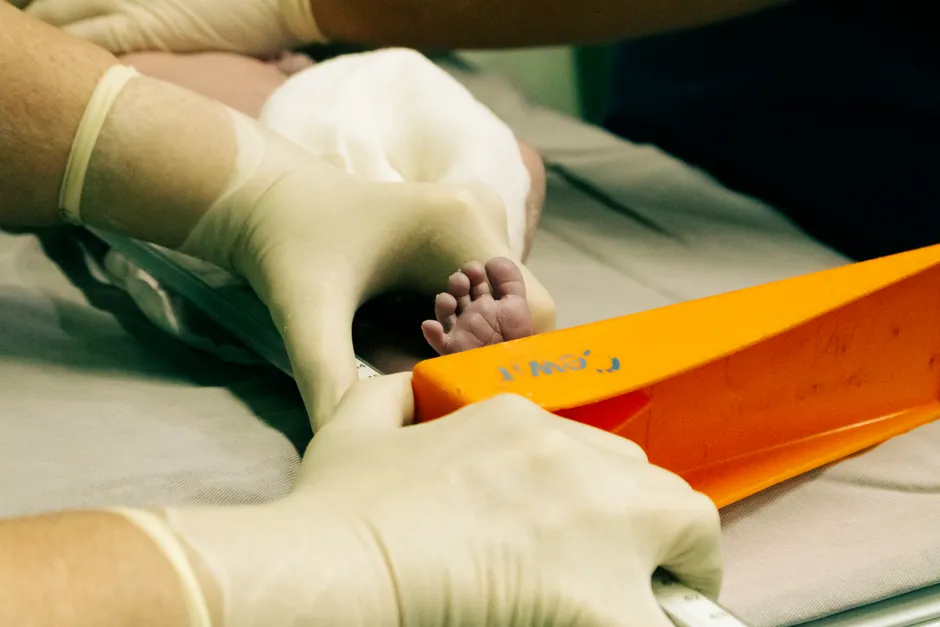
Photo by Bruno Curly on Pexels
Köln does host one genuinely dedicated regional institution connected to newborn screening, though it covers a separate test: newborn hearing screening, not the metabolic heel-prick. The Hörscreening-Zentrum Nordrhein, founded in 2007 as a joint project between maternity facilities across the Nordrhein region and Uniklinik Köln’s own ENT department (Phoniatrie und Pädaudiologie), coordinates and tracks hearing screening and any necessary follow-up examinations until a child’s hearing status is fully clarified, reminding parents directly if a follow-up appointment is missed rather than letting it quietly lapse. It’s a genuinely Köln-based regional hub, a structural contrast with the metabolic screening, which routes through laboratories entirely outside the city.
What Real People Say
The recurring pattern in how Köln parents describe this is genuine, if brief, confusion: a heel-prick happened at some point in the newborn blur, and then nothing, no call, no letter, no mention at the next Kinderarzt visit. Once parents learn that silence is the actual designed outcome for a normal result, rather than an oversight, the confusion tends to resolve quickly, though it’s a detail that would be genuinely useful to know upfront rather than discovering after searching for an answer.
Parents who specifically wanted confirmation of a normal result describe simply asking their birth clinic, hebamme, or the screening laboratory directly and getting a straightforward answer, the information isn’t hidden, it’s just not pushed to you automatically the way other results are. Parents who went through the hearing-screening follow-up process separately mention the Hörscreening-Zentrum Nordrhein’s own reminder calls as the part that reassured them most, a concrete, Köln-based point of contact in a process that otherwise feels diffuse and lab-based.
Step by Step
- Know that the heel-prick test your newborn had runs through an accredited screening laboratory, not a single NRW state office and not part of your Kinderarzt’s regular U-checkups.
- Don’t interpret silence about a normal result as something going wrong, that result generally isn’t proactively communicated at all.
- If you want explicit confirmation of a normal result, ask your birth clinic, hebamme, or the screening laboratory directly, this information is available on request.
- Understand that a concerning result now triggers direct contact from the lab within 72 hours, since the 14 January 2025 rule change, rather than routing through the clinic first.
- Keep the heel-prick screening mentally separate from the U-Heft and U1-U9 schedule, they’re related in spirit but run through entirely different institutions.
- If your baby’s hearing screening needs a follow-up appointment, expect the Hörscreening-Zentrum Nordrhein at Uniklinik Köln to track and remind you, rather than assuming you have to manage that follow-up entirely on your own.
Compliance Note
This page explains the general federal framework for newborn screening (Neugeborenenscreening) in Germany and the related regional hearing-screening tracking hub based in Köln, current as of mid-2026. It is not medical advice. For questions about your specific child’s screening or results, contact your birth clinic, hebamme, Kinderarzt, or the screening laboratory directly.
FAQ & Common Pitfalls
We never heard anything back about our baby's heel-prick test. Does that mean it didn't happen, or got lost?
Almost certainly neither. A normal (unauffällig) result generally isn't proactively communicated to parents at all under the federal framework, you're only told if you specifically ask. Silence is the expected, designed outcome for a normal result, not a sign that something went wrong or got lost in the process. If a result actually raises concern, the rules changed in your favor as of 14 January 2025: the screening laboratory itself now has to contact you directly within 72 hours, rather than that information routing through the clinic first and potentially adding delay.
Which office in Köln runs this screening, the way LGL runs it in Bavaria?
There isn't a direct equivalent, and that's a genuine structural difference worth understanding. North Rhine-Westphalia doesn't operate one central state health office dedicated to the metabolic heel-prick screening the way Bavaria's LGL does. Instead, your baby's blood sample is sent by the birth clinic or hebamme to one of the accredited screening laboratories in Germany's DGNS network, commonly a specialized center like Neugeborenenscreening Heidelberg, which processes samples from several states, North Rhine-Westphalia included, rather than one dedicated NRW-only agency.
Is this the same thing as the U-Untersuchungen or the U-Heft?
No, and this is exactly the confusion worth clearing up. The Neugeborenenscreening is a distinct, one-time program run through an accredited screening laboratory, separate from your Kinderarzt's practice and the ongoing U1-U9 checkup sequence documented in the U-Heft. It happens once, very early, using a heel-prick blood sample, rather than being part of the ongoing U-checkup schedule.
Is there anything related to newborn screening that Köln actually does have its own dedicated office for?
Yes, though it's technically a separate test: newborn hearing screening. The Hörscreening-Zentrum Nordrhein, founded in 2007 and based at Uniklinik Köln's ENT (Phoniatrie und Pädaudiologie) department, coordinates and tracks newborn hearing screening and any needed follow-up examinations across the entire Nordrhein region, reminding parents directly if a follow-up appointment gets missed. It's contactable at 0221-478-88759, and it's a genuinely Köln-based regional hub, unlike the metabolic heel-prick screening, which routes through laboratories outside the city.